Baseline demand
Existing wattage, operating hours, space usage, fixture condition, and maintenance frequency establish a realistic starting point.
Sustainability
Sustainable lighting is not only a lower-wattage fixture swap. It is the disciplined combination of efficient luminaires, right-sized output, occupancy logic, daylight response, scheduling, maintenance data, and a plan for how the building will actually operate after the upgrade. Signify helps teams compare the existing condition against a realistic connected-lighting scenario so savings are tied to behavior as well as hardware.
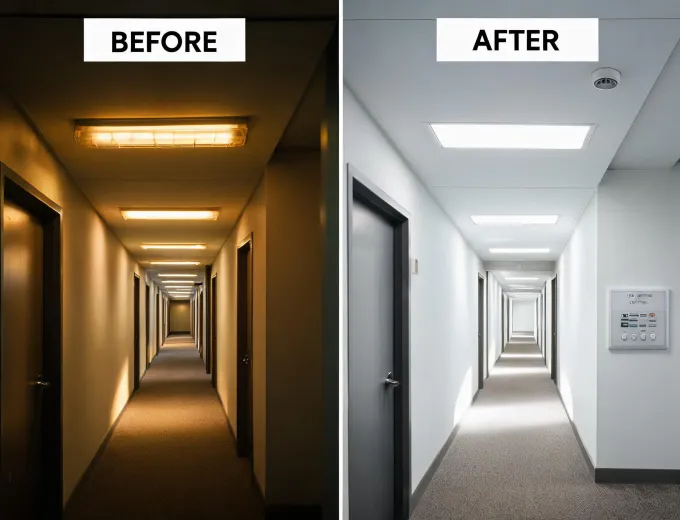
Existing wattage, operating hours, space usage, fixture condition, and maintenance frequency establish a realistic starting point.
Occupancy response, daylight harvesting, dimming profiles, scene presets, and scheduling determine how much of the installed capacity is actually used.
Better visibility, fewer maintenance visits, data-enabled management, and adaptable zones support savings that survive beyond the first utility bill.
The calculation should remain transparent. A warehouse that runs two shifts has different savings potential than a retail floor with long display hours or a school building with seasonal occupancy. A greenhouse may care less about simple reduction and more about crop response per unit of energy. For that reason, Signify frames sustainability as an applied design conversation. We connect product selection to the control strategy and make the assumptions visible enough for owners, engineers, and operations teams to challenge them early.
Replace aging ceiling fixtures with efficient panels or linear systems, then add occupancy and daylight logic that responds to hybrid work patterns.
Use area lighting controls to lower output during low-traffic hours while keeping safety, uniformity, and municipal expectations in view.
Improve efficiency while reducing lift-truck service events through longer-life high-bay fixtures and documented zone controls.
Send operating hours, existing fixture types, and control goals. We will help frame the next step.